Skip to content
Software Engineer | LLM EngineerChennai, India

Building Software.Exploring Intelligence.

I'm Kishore, a Software Engineer focused on building scalable applications and intelligent systems. I work across full-stack development, mobile engineering, and LLM-powered applications.

  • Software Engineering
  • LLM Engineering
  • RAG Systems
  • AI Infrastructure
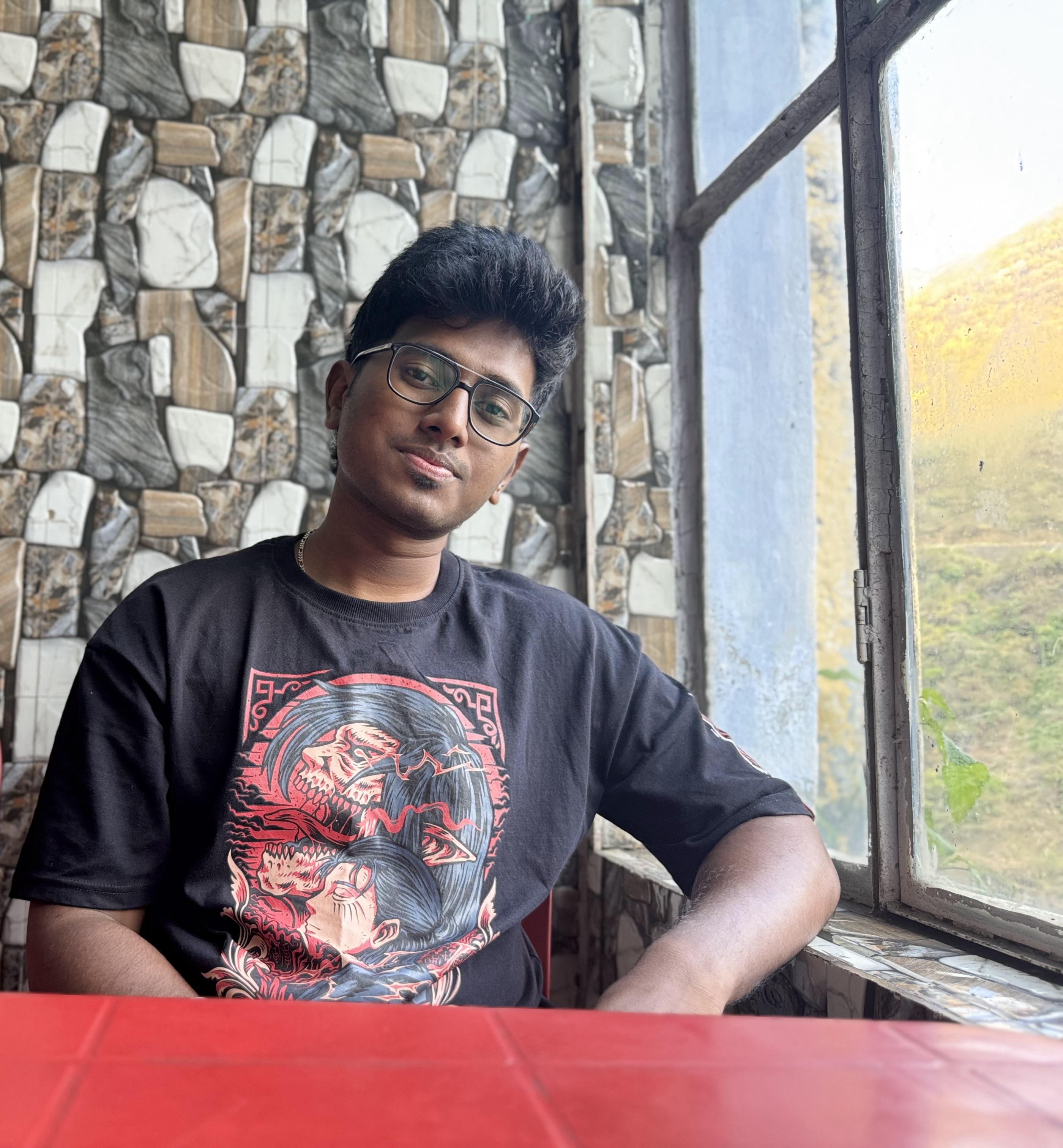
Portrait of Kishore K.

Kishore K.

Software Engineer | LLM Engineer

LLM · RAG

About

Engineer first. Curious about what's under the model.

I'm a software engineer at DataFlo.ai in Chennai, India, where I work on the product end to end — from research and prototyping to shipping features and taking ownership of how they hold up in production.

Before that I was at ASSA ABLOY Group, modernising an enterprise quoting (CPQ) platform from legacy VB.NET to .NET Core 8, React and PostgreSQL. That's where I learned to work inside a large codebase with real business rules. On my own time I built ErrorSnap, a VS Code extension with 150+ active installs.

These days most of my work is on LLM-powered applications: retrieval pipelines, conversational features and generated reports.

Building RAG systems taught me that the hard part is rarely the model call. It's the data underneath: whether the index still matches the source, whether context reaches the model, whether a decision survives the next refactor. My independent projects, RAGGuard and WhyAnchor, both came out of that.

Long term I want to work deeper in the stack — understanding how transformers work internally, how models are trained, evaluated and served — and focus on LLM engineering and AI infrastructure.

Based in
Chennai, India
Currently
DataFlo.ai
Previously
ASSA ABLOY Group
Education
MCA, SRM University
Focus
LLM & RAG engineering

Experience

Where I've been building

Professional work only. Independent projects are listed separately below.

  1. Software Engineer & RAG Engineer

    DataFlo.aiChennai, India

    Sep 2026 — Present

    Building the product across web, mobile and LLM features — from research and prototypes through to production releases.

    Responsibilities

    • Build product features end to end, from design and implementation to release.
    • Research and development on LLM and retrieval-augmented generation (RAG) features.
    • Help manage the team's delivery and take ownership of product quality.
    • Mobile engineering in React Native: WebViews, deep linking, authentication integrations, app releases and debugging.

    Key contributions

    • Deep Chat & report generation

      Worked on the deep chat feature and the report generation built on top of it.

    • RAG pipeline

      Contributed to the retrieval pipeline that powers the product's RAG system.

    • TypeScript
    • React
    • React Native
    • LLMs
    • RAG
  2. Associate Web Developer

    ASSA ABLOY GroupChennai, India

    From Jul 2024

    Full-stack modernisation of TrackPoint, an enterprise CPQ (configure-price-quote) platform used across multiple global brands and distributor territories.

    Responsibilities

    • Migrated a legacy VB.NET quoting system to a .NET Core 8 REST API architecture, reducing technical debt for a team of 10+ internal developers.
    • Implemented business rules: minimum discount validation, zero-price product checks and automated quote approval workflows.
    • Built responsive React components with PrimeReact and PrimeFlex — quote tracking, project detail pages and navigation — with role-based access for admin roles.

    Key contributions

    • 1st prize, company Innovation Day

      Built a unified product discovery platform connecting 20+ internal applications, enabling demo requests and cross-application data access.

    • Fewer manual quote reviews

      Automated validation and approval routing reduced erroneous quote submissions and manual review for sales operations.

    • .NET Core 8
    • C#
    • VB.NET
    • React
    • Node.js
    • PostgreSQL
    • PrimeReact

Projects

Independent products I've built

RAGGuard and WhyAnchor came out of problems I ran into building LLM systems: indexes that silently drift, and decisions that AI agents forget.

Live · Public betaIndependent project

RAGGuard

Know when your RAG index is wrong — before your users do.

An independent integrity and reconciliation platform for RAG systems. It compares source documents in Amazon S3, the ingestion pipeline's processing manifest, and the vector index in Qdrant or pgvector — and finds what drifted silently while every job reported success.

The problem
RAG indexes rot quietly: documents never get embedded, vectors describe old versions, deleted files stay searchable, and chunks land under the wrong tenant — all while the pipeline says "success". Answer-grading tools don't look at the index underneath.
My role
Designed and built the product end to end: reconciliation engine, issue ledger, repair workflow, web interface, HTTP API, CLI and MCP server, and the hosted deployment.

What it does

  • Detects missing, stale, partial, superseded, orphaned and duplicate embeddings, empty vectors and cross-tenant chunks.
  • Read-only by construction — S3 list/head, READ ONLY database transactions, Qdrant scroll/query.
  • Every finding carries its evidence and a repair plan sent via HMAC-signed webhook to your own worker.
  • Independent verification after repair before any approved cleanup.
  • Demo mode with a synthetic multi-tenant corpus and 47 injected faults.
  • ragguard CLI and MCP server on PyPI for CI gates and AI coding assistants.

It never writes to your systems. RAGGuard audits and proves; your own worker repairs, and RAGGuard independently verifies the result.

  • Python
  • FastAPI
  • SQLAlchemy
  • PostgreSQL / Supabase
  • Qdrant
  • pgvector
  • Amazon S3
  • React
  • TypeScript
  • Docker
  • MCP
  • Vercel

Free during beta. Known limits (in-memory aggregation, minimal accounts) are documented in the repo.

Architecture
  1. 01S3 · Manifest · Qdrant

    Your infrastructure, read-only

  2. 02Reconciliation engine

    source vs manifest vs index

  3. 03Issue ledger

    Evidence · UI · API · CLI · alerts

  4. 04Your worker repairs

    Signed webhook → independent verification

RAGGuard product walkthrough title card: Documents and Isolation
ReleasedIndependent project

WhyAnchor

Your AI coding agent forgets why your code is the way it is. This remembers for it.

A local-first command-line tool that stores engineering decisions as Markdown files in your git repo, delivers them to AI coding agents (Claude Code, Cursor, Codex), and warns you when a note no longer matches the code it describes. Formerly named ctx-memory.

The problem
Important decisions aren't documented in the code, so developers — or AI agents starting each session from zero — can unknowingly change critical business rules and break existing agreements.
My role
Created the project: CLI, symbol-level anchoring and staleness checks, MCP server, agent config generation and the local knowledge-graph UI. Published on npm.

What it does

  • whyanchor capture records a decision anchored to a file or symbol, e.g. src/pricing.ts#calculateDiscount.
  • whyanchor generate writes notes into .claude/CLAUDE.md, AGENTS.md and Cursor rules.
  • Serves memory live over MCP so an agent can ask about the file it's editing.
  • whyanchor check fingerprints anchored code and flags stale notes across four levels — hashes and git history, no AI.
  • whyanchor connect wires up Claude Code, Cursor and Codex in one command, merging existing config.
  • whyanchor viewgraph shows how decisions connect as a local graph.

Anchored to symbols, not files — an unrelated edit in the same file doesn't raise a false alarm. Plain Markdown, no account, no network calls.

  • TypeScript
  • Node.js
  • CLI
  • MCP
  • Git
  • Next.js
  • npm

The repository previously lived at github.com/kishore600/ctx-memory — it's the same project.

How it works
  1. 01Capture

    Decision → .memory/entries/*.md

  2. 02Anchor

    File or symbol + fingerprint

  3. 03Deliver

    CLAUDE.md · AGENTS.md · MCP

  4. 04Check

    Flags notes the code moved past

More things I've shipped

ReleasedIndependent projectNov 2024

ErrorSnap

Stop re-solving the same compile error.

A VS Code extension that watches compilation errors in real time, captures their context, and suggests fixes you've already resolved before.

  • Captures error message, file and line number as errors appear.
  • Stores resolved errors and surfaces matching fixes when the same or a similar error recurs.
  • 150+ active developer installs on the VS Code Marketplace.
  • TypeScript
  • VS Code Extension API
  • React

Skills

Tools I work with

Markers show where each one has been used. Professional work Independent projects

Programming

  • JavaScript
  • TypeScript
  • Python
  • C#

Frontend & Mobile

  • React
  • React Native
  • Next.js
  • Tailwind CSS
  • PrimeReact

Backend

  • Node.js
  • .NET Core 8
  • FastAPI
  • REST APIs

Databases

  • PostgreSQL
  • Supabase
  • MongoDB
  • MySQL
  • Qdrant
  • pgvector

AI & LLM

  • Large Language Models
  • Retrieval-Augmented Generation
  • Embeddings
  • Vector databases
  • Prompt engineering
  • AI agents
  • MCP

Infrastructure & Tools

  • AWS S3
  • Docker
  • Git
  • Google Cloud Platform
  • Google Play Console
  • Android Studio

Learning & research

Currently Exploring

Things I'm actively studying to understand LLMs from the inside. These are learning goals, not claimed expertise.

  • 01

    Transformer architecture

    Attention, positional encodings and how the pieces fit together, from the paper up.

  • 02

    PyTorch & deep learning

    Writing training loops and small models by hand to build intuition.

  • 03

    LLM fine-tuning

    When fine-tuning beats retrieval or prompting, and how to set it up properly.

  • 04

    LoRA & QLoRA

    Parameter-efficient adaptation and quantised training on modest hardware.

  • 05

    RAG evaluation

    Measuring retrieval and answer quality, beyond eyeballing outputs.

  • 06

    Inference optimisation

    Batching, KV caching, quantisation and what drives latency and cost.

  • 07

    Model training & paper reproduction

    Reproducing published results to understand what actually matters.

  • Notes and experiments go on GitHub as they mature.

Education

Education

  1. SRM University, Ramapuram

    Master of Computer Applications (MCA)

    Chennai, India

    Jul 2022 — May 2024

Contact

Have an interesting engineering problem?

I'm happy to talk about software engineering, RAG systems, LLM infrastructure — or a role where I can work on them.

Opens your email app with the message ready to send.